Author: Neil Dundas (22 April 2026)
The domain name system (DNS) is often described as the “phonebook of the Internet,” but that analogy only scratches the surface. Beneath every domain name lies a complex web of policy, governance, and operational rules that shape how the Internet functions at a national and global level.
In South Africa, the .za namespace is governed by a unique and evolving policy ecosystem, one that directly affects registries, registrars, ISPs, businesses, and ultimately every internet user. Yet, despite its importance, many stakeholders remain unaware of how policy is formed, or how they can influence it.
This article explores the current state of domain name policy in South Africa, compares it to global best practice, and considers how a more structured, participatory model could shape the future of .za.
Understanding the .ZA Policy Ecosystem
The .za regulatory environment is not defined by a single rulebook. Instead, it is a layered system made up of:
- Legislation and regulatory oversight
- Contracts between registries and registrars
- Operational policies and technical standards
- Procedures governing the domain lifecycle
These policies influence everything from how domains are registered and transferred to how disputes are resolved and how abuse is mitigated.
At a practical level, policy governs:
- Domain creation, expiration, deletion, and recovery
- Transfers and updates between registrars
- DNS abuse handling and alternative dispute resolution (ADR)
- Registration data services (WHOIS/RDAP)
- The roles and responsibilities of registries and registrars
In other words, policy is not abstract, it directly shapes the reliability, security, and trustworthiness of the South African internet.
Where Did .ZA Policy Come From?
The origins of domain name policy in South Africa are rooted in a combination of early internet community practices, later formalised through regulatory intervention and institutional oversight.
Today, the ecosystem includes multiple stakeholders:
- ZADNA (the regulator), providing strategic direction and oversight
- ZARC (registry operator), implementing and operationalising policy
- Registrars and ISPs, who interface with end users
- Registrants, who are ultimately affected by policy outcomes
This multi-actor environment has evolved organically, resulting in a system that is flexible, but not always consistent or transparent.
How Policy Development Works in .ZA Today
Currently, policy development in .za can be characterised as:
- Regulator-led, with ZADNA setting the framework
- Registry-driven in implementation, often influenced by legacy rules and operational realities
- Industry-influenced, with input from registrars, ISPs, and other stakeholders
- Informal in participation, with limited structured pathways for community engagement
This model has some clear advantages. It allows for agility and responsiveness, particularly in operational matters. However, it also introduces challenges:
- Limited transparency in how decisions are made
- Inconsistent opportunities for stakeholder participation
- Difficulty in building broad-based consensus
- Risk of policy being shaped by a narrow set of voices
In short, the system works, but it could work better.
A Global Benchmark: The ICANN Policy Development Process
To understand what “better” might look like, it’s useful to examine the ICANN Policy Development Process (PDP), which governs global domain name policy for generic top-level domains (gTLDs).
The ICANN PDP is defined by several key principles:
- Bottom-up development: Policy originates from the community, not the regulator
- Multi-stakeholder participation: Governments, industry, civil society, and technical experts all have a voice
- Structured processes: Clearly defined stages, timelines, and procedures
- Public consultation: Open comment periods ensure transparency and inclusivity
- Consensus-driven outcomes: Policies are refined through negotiation and agreement
- Contractual enforcement: Final policies are embedded into registry and registrar agreements
This model is not without complexity, it can be slow and resource-intensive, but it provides legitimacy, predictability, and broad stakeholder buy-in.
Could a Similar Model Work for .ZA?
The question, then, is whether elements of the ICANN PDP could be adapted for the South African context.
A potential .za Policy Development Process might include:
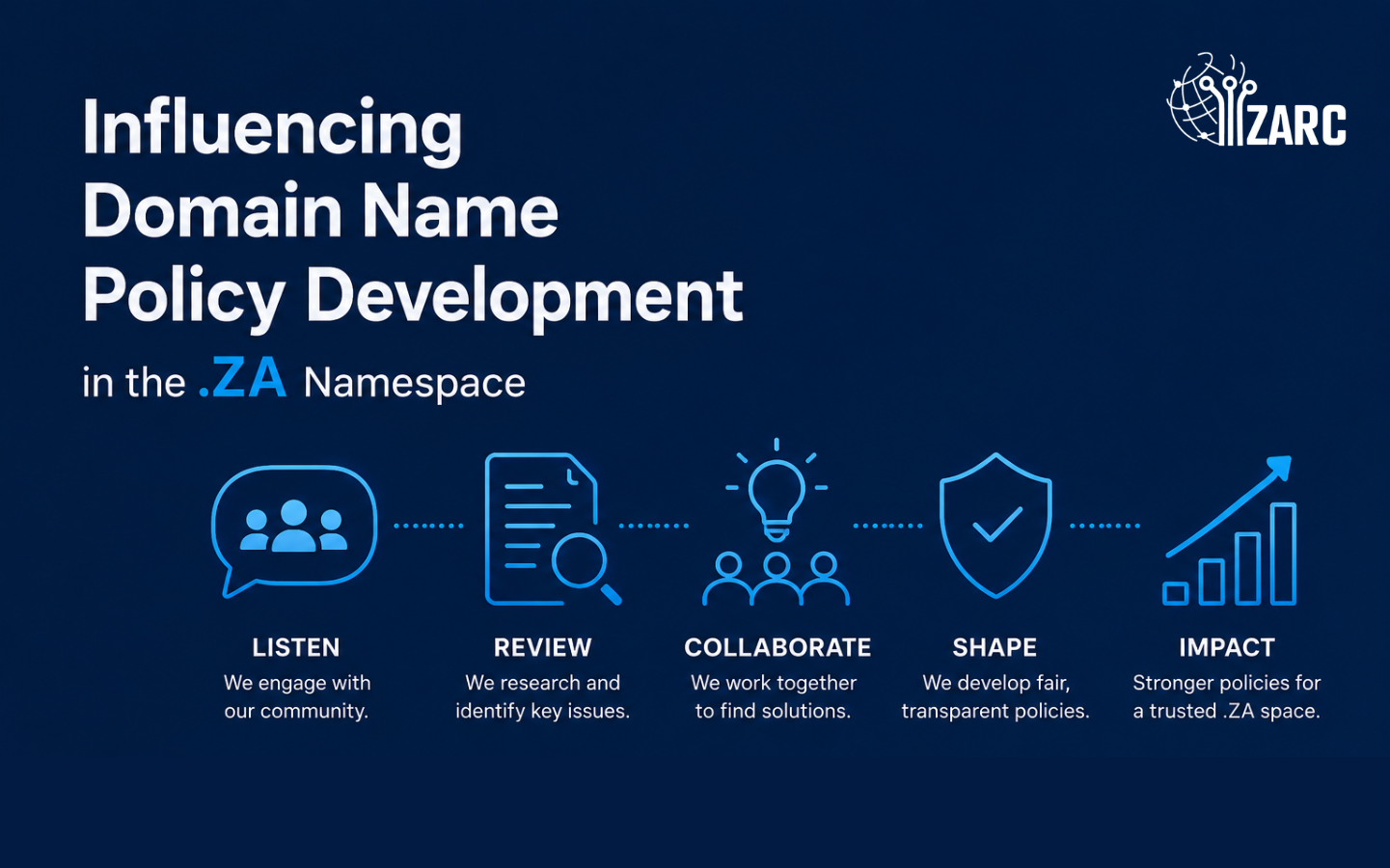
- Clearly defined stages for policy initiation, discussion, and adoption
- Formalised channels for stakeholder participation
- Transparent consultation processes
- Mechanisms for building consensus across the ecosystem
- Defined roles for regulator, registry, and community
Such a model would not need to replicate ICANN in full. Instead, it could be tailored to the scale and needs of the South African internet community, retaining flexibility while introducing greater structure.
The Opportunity:
The .za ecosystem is already multi-stakeholder in nature. The missing piece is not participation, it is structured participation.
By introducing a more formalised PDP, South Africa has an opportunity to:
- Increase transparency and trust in policy decisions
- Broaden participation beyond a small group of insiders
- Improve policy quality through diverse input
- Align more closely with global best practices
- Strengthen the resilience and credibility of the namespace
Importantly, this is not about replacing existing institutions, but about enhancing how they interact with the community.
Conclusion
South Africa’s domain name ecosystem stands at an inflection point. It has a solid foundation, a capable set of institutions, and an engaged technical community.
What it needs now is a more structured approach to policy development, one that unlocks broader participation, improves transparency, and ensures that the future of .za is shaped by the community it serves.
The question is no longer whether policy matters.
The question is: who is helping to shape it?